
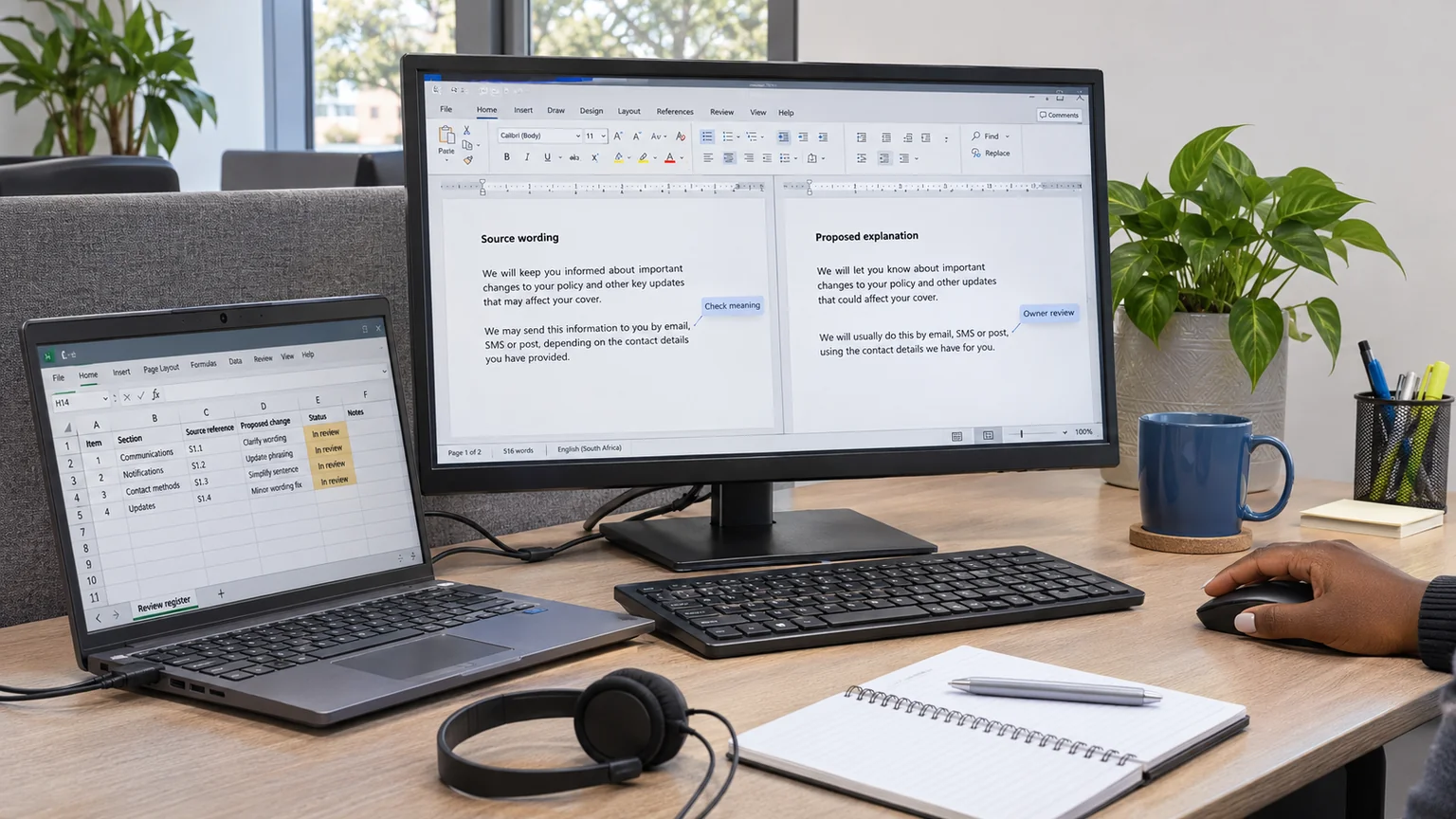
An insurance explainer can become inaccurate during an apparently helpful edit. A writer shortens a sentence, a designer removes a qualification to fit a frame, or a voice-over sounds more definite than the approved source. I would treat those changes as content decisions, not simply production improvements.
My role in this example is to coordinate the work and make its review trail usable. I would not decide what a policy covers or certify that a communication meets its legal obligations. The insurer needs to nominate the appropriate product and specialist reviewers. I need to make sure they can see what is being proposed, what supports it and which version they are accepting.
Consider a fictional short explainer about how a customer starts an enquiry. There are no premiums, benefit promises or claims outcomes in the example. Even that limited brief needs a controlled source and a clear route for approval.
I give every substantive statement a source
Before production begins, I would create a claim register. Here, claim means a statement in the proposed content, not an insurance claim. Each row would contain the draft wording, source identifier, source version, relevant passage, reviewer and decision status.

The register would help distinguish an approved process description from a writer's interpretation. If the source says that someone can submit an enquiry through a particular channel, I would not let the script quietly turn that into a promise of a response within a particular time.
I would also record when the source owner confirmed that the material was current. A document being available in a shared folder is not sufficient evidence that it remains the right basis for a public explanation.
I make simplification visible to the reviewer
Plain language is valuable, but shortening can change meaning. I would show the proposed sentence beside its source and identify what was removed or rephrased. The reviewer can then assess the change directly instead of trying to reconstruct it from a polished video.
The UK's Financial Conduct Authority describes financial promotions across media as needing to be clear, fair and not misleading. That is UK regulatory context, not a statement of South African requirements. It reinforces why I would involve the client's appropriate specialists rather than assume that attractive presentation establishes accuracy. FCA financial promotions overview.

In the fictional enquiry video, a proposed simplification might replace a long internal process label with a shorter audience-facing phrase. I would ask whether the shorter phrase still identifies the correct step. If it creates a promise that the source does not support, it needs revision before recording.
I review the whole communication, not only the script
A correct sentence can sit beside a misleading visual. A green confirmation icon, a triumphant animation or an overly reassuring tone may suggest that an outcome is certain even when the wording does not say so.
I would therefore give the reviewer the script, storyboard and intended on-screen wording together. Later, I would ask them to review the actual cut, including the relationship between narration, captions and images. The production team should not treat approval of a text document as acceptance of every interpretation introduced during filming or design.
The tracker would identify the item being reviewed: script v03, storyboard v02 or review cut v01. A general approved label attached to the project would conceal which decisions remain open.

I keep unresolved questions out of the release package
If a source is ambiguous, I would record the question and its owner rather than ask the editor to choose the most convenient interpretation. The issue could affect one sentence or require the sequence to be redesigned. Either way, its effect on production should be visible.
For example, the fictional brief might not establish whether a channel accepts new enquiries or only follows up existing ones. That is a bounded question for the product owner. It should not become a speculative line in the narration because the recording session is approaching.
I would identify which work can continue while the answer is pending. Music selection or an unrelated transition might progress; recording the disputed sentence would remain blocked. This keeps the team productive without concealing the unresolved decision.
I connect acceptance to a version and a channel

A short social clip, a website video and a longer presentation are different release items. Cropping a video can remove context, while shortening it can separate a qualification from the statement it explains.
I would create a release manifest that identifies each file, its version, its intended channel and the acceptance recorded against it. A new derivative would receive its own review status rather than inherit approval automatically from the longer master.
The same applies to captions and translated versions. I would ask the relevant reviewers to confirm meaning and production staff to check timing and display. Those checks support each other, but neither substitutes for the other.
I leave a correction route after publication
The project does not become ownerless when the file goes live. I would identify who receives notice of a source change, who assesses the affected content and who can authorise an update or withdrawal.

The handover would include the current release list, source references and links to the decisions. If the enquiry route changes, the owner can find the affected sentence and its derivatives without searching every old export.
I would also distinguish a proposed correction from a verified replacement. The record should show when the revised file was accepted and when the actual public destination was checked. Uploading a file somewhere is not the same as confirming that the audience now receives the intended version.
For me, traceability makes the communication easier to maintain as well as easier to review. It connects a public statement to its source, its interpretation and the people responsible for accepting it, while keeping my production role clear.
Research and example note
Prepared on 3 November 2026 for the 7 November slot. The FCA overview was last updated in May 2024 and is used only for explicitly identified UK background, with fewer than 80 words derived from it. The workflow and enquiry example are fictional. This article provides no insurance recommendation, policy interpretation or compliance certification.